Workspace field notes
How to choose a desk pedal exerciser with included resistance bands
A desk pedal exerciser with included resistance bands needs two separate fit checks: room for your knees through the full pedal arc, and a stable base with a clear, secure band attachment path. Measure from your everyday chair, inspect the manufacturer’s instructions, and start with light effort that does not interrupt typing or pull the chair out of position. Included bands are an optional movement break, not proof that the device suits every workspace.
Last updated: November 10, 2026
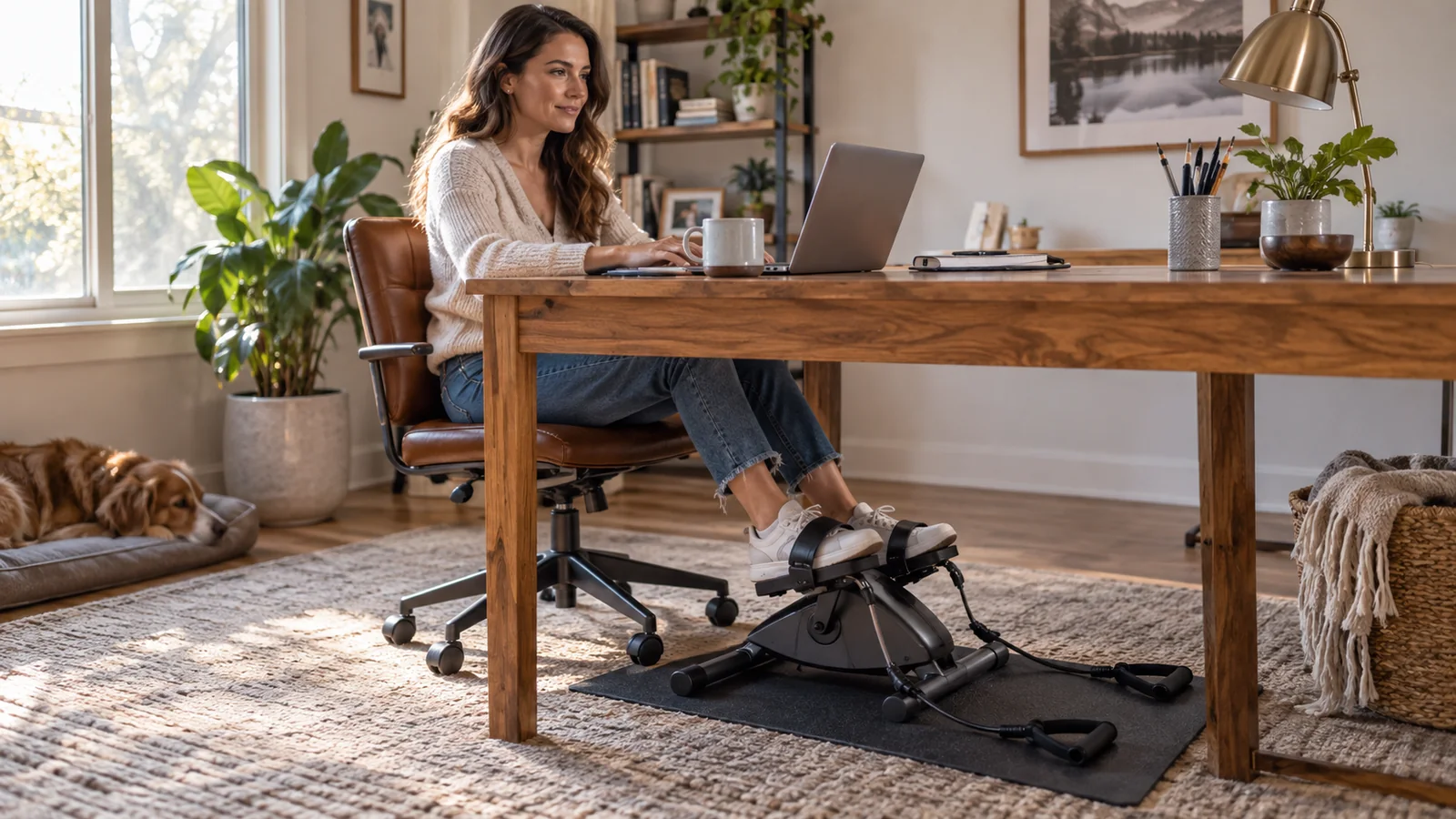
Begin with the workday you actually have
People often search for an all-in-one solution because the promise is appealing: quiet pedaling below the desk, a little upper-body movement when the chair is still, and no need to carve out a separate workout corner. The better starting point is the real desk zone—its knee clearance, chair movement, floor surface, and storage options. For a useful market overview, the source article best desk bike pedal exercisers with resistance bands included can help identify product categories; then use the checks below to decide whether a particular configuration belongs in your room.
A pedal exerciser and a pair of bands do different jobs. Pedals ask for a stable lower-body arc and adequate clearance. Bands add a pulling line, handles, connectors, and a need to control return tension. A device can be a reasonable fit for one activity and a poor fit for the other. Treating them as separate options keeps the evaluation honest and avoids the idea that “included” automatically means “useful.”
Measure the pedal zone in a seated position
Measure from the chair you use, not from an empty desk. Start with the underside of the desktop and any crossbar, drawer, or cable tray that sits beneath it. Then consider the height of the pedal at the top of its rotation, the travel of the chair, and the space your heels need. A tape measure, a book placed at a likely pedal height, and a slow knee lift can expose a collision long before a box arrives. If the product listing names only the base dimensions, look for the overall operating height or ask support before assuming the unit will clear the desk.
Read included bands as a hardware system
The phrase “resistance bands included” tells you very little about how they behave. Look for images and documentation that show whether bands attach to the base, pass through a fixed point, or are simply packed beside the pedal unit. Inspect connector style, stated maximum load if available, handle shape, and whether the base has enough mass and footprint to stay put under light pulling. A good product description makes the route of the band obvious. If the route is not clear, do not fill the gap with a hopeful assumption.
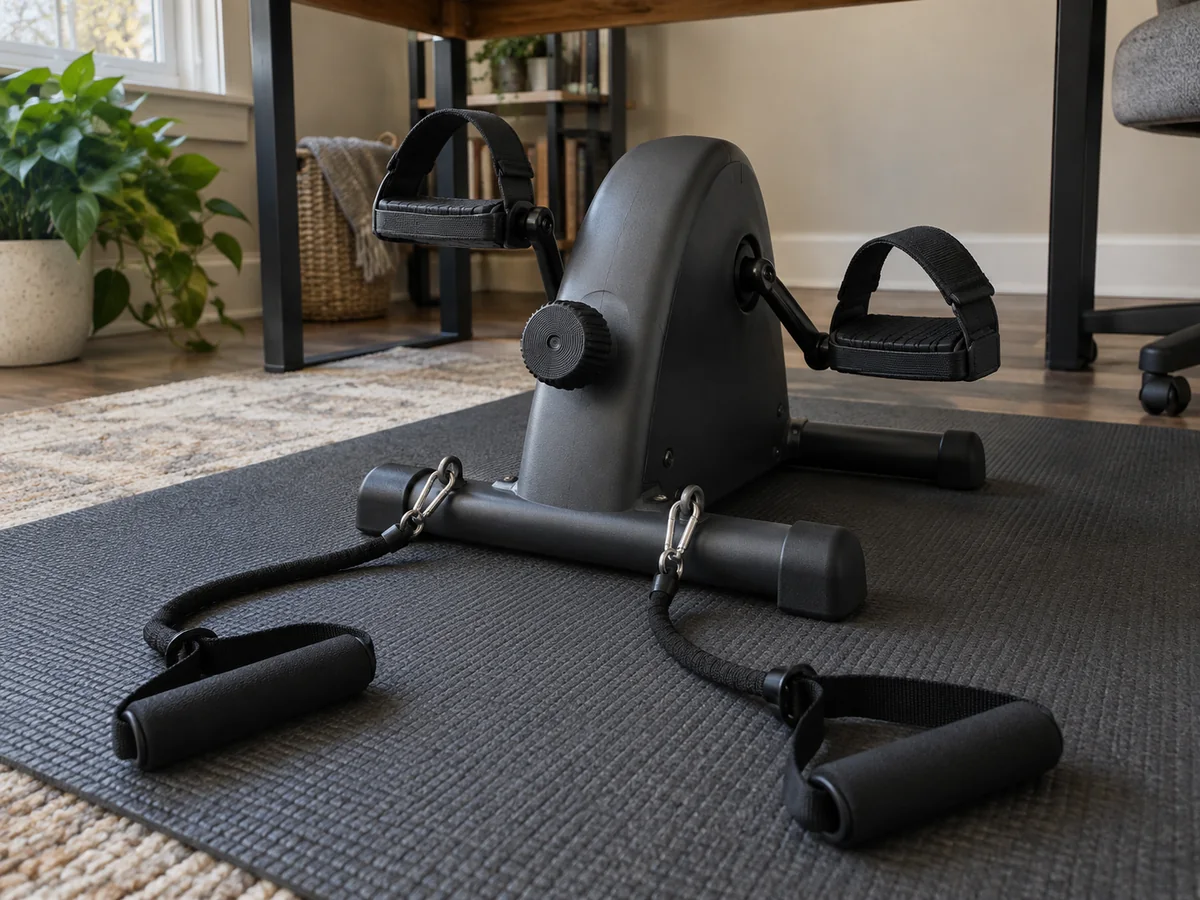
Prioritize a base that stays where you place it
Stability is a system outcome: the device, floor, chair, resistance, and user position all contribute. Rubber feet and a broad base help, but a smooth floor may still call for a nonslip mat. Start with a very light pedal setting and watch for travel or rocking. When using bands, reduce the pull until the base remains planted. Movement tools should not require you to brace through the desk or hook a foot around a furniture leg. A stable first setting matters more than a spectacular top setting.
Separate quiet operation from silent operation
Marketing language around quiet operation is relative. In a calm room, a slight rotation sound or vibration through a desk can be noticeable; on a video call, an otherwise small noise may become distracting. Consider the surface below the unit, the distance to a microphone, and whether you will use it while typing. A floor mat can limit vibration and protect surfaces, but it cannot correct a loose part or an unstable setup. Plan to start at gentle resistance and use a short, focused trial during normal work.
Make the pedal action compatible with focused work
The purpose of an under-desk device is not to recreate an intense cycling session while answering email. At a useful setting, the pedal arc should be easy enough that your shoulders, hands, and attention are not recruited to manage it. If you need to shift forward, grip the armrests, or pause typing frequently, change the arrangement. Some people may prefer to pedal during reading, listening, or a routine call rather than while drafting. That is not a failure; it is a realistic match between movement and cognitive demand.
| Question | Evidence to look for | Why it changes the decision |
|---|---|---|
| Will it clear the desk? | Operating height and seated knee test | Prevents a blocked pedal arc. |
| Will it stay stable? | Base, feet, mat, and light-tension trial | Reduces sliding and bracing. |
| Are bands genuinely usable? | Visible attachment path and intact handles | Turns “included” into a checkable feature. |
| Can it fit the routine? | Noise, setup time, storage path | Supports consistent use instead of clutter. |
Use band work in short, deliberate blocks
Bands can be a welcome change from pedaling, but they deserve a clear beginning and end. Put the chair in a stable position, confirm that the cord path is unobstructed, and begin with a small pull that you can release slowly. Keep the range comfortable and avoid twisting to compensate for an awkward line of pull. The practical virtue of included bands is convenience, not a promise to train every muscle from a desk chair. If the attachment does not feel obvious and secure, set the bands aside and follow the manufacturer’s direction.
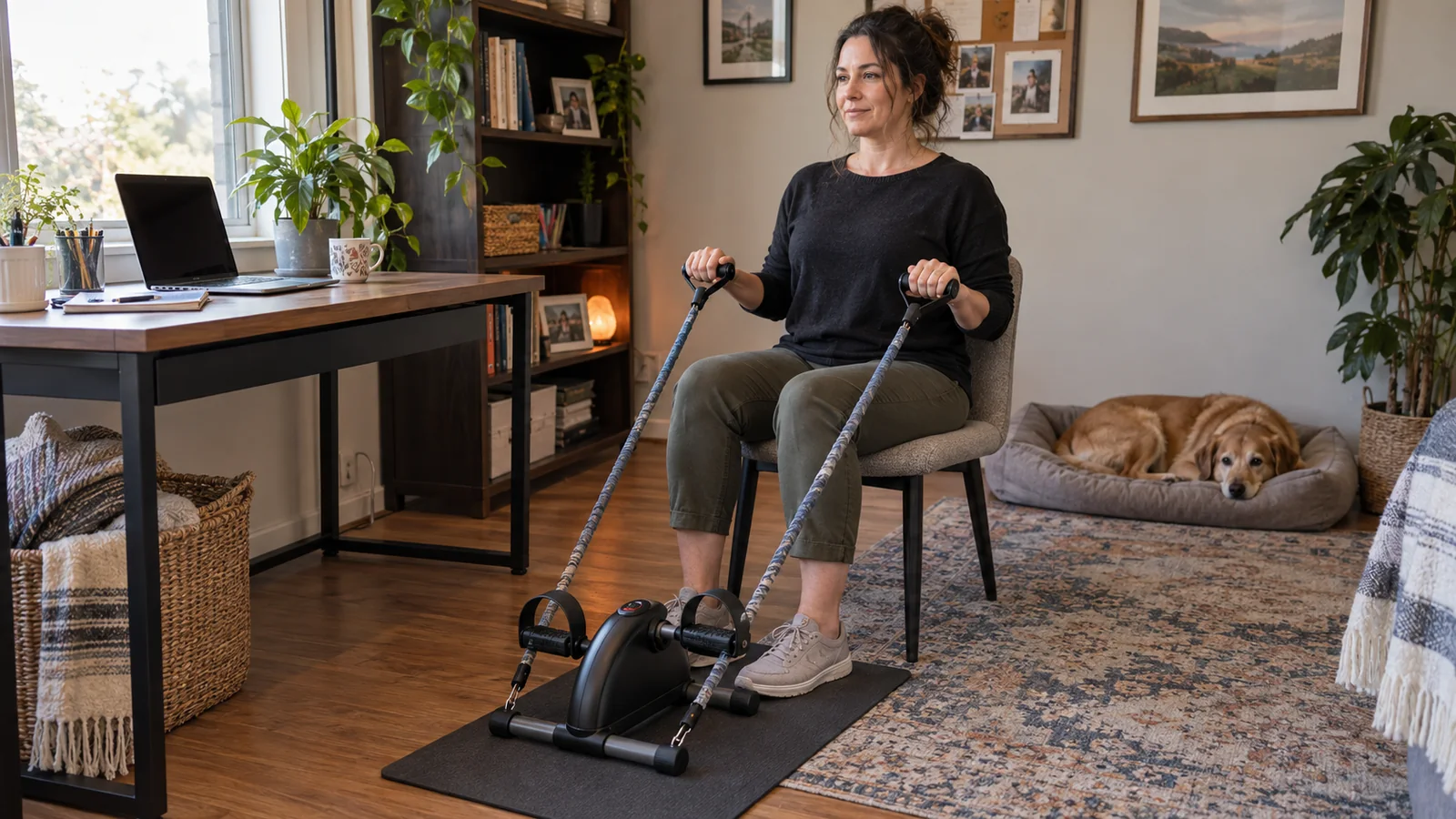
Compare routine friction, not feature count
A useful comparison asks: Can this be placed, used, stopped, and stored without disrupting the room? Dimensions matter, yet the daily friction often hides in details such as a heavy unit without a clear carry point, bands that tangle after each use, pedals that scrape a thick rug, or a chair that rolls away. Make a quick written scorecard for clearance, base stability, adjustment, noise, band connection, storage, and support information. The unit with fewer theatrical extras may create the steadier habit.
Keep claims proportional to the evidence
A compact pedal exerciser can support a movement break, but it cannot replace individualized medical advice, rehabilitation, or a broader activity plan. Avoid judging a product by broad health promises. Judge it by whether its materials, dimensions, setup instructions, and return policy help you make a careful decision. If pain, numbness, dizziness, an unresolved injury, or a health condition is part of the picture, stop and seek advice from a qualified clinician before changing your activity routine.
A decision checklist before checkout
- I measured the operating space from my own chair.
- I understand whether the bands attach to the unit and how their pull path works.
- I have a plan for floor protection, stability, and storage.
- I can start at a low setting without asking the desk or chair to stabilize me.
- I will use the device as a manageable movement option, not as medical treatment.
Choose for the ordinary Tuesday
The most credible product choice is often the one that handles the least glamorous parts of the workday: a chair that shifts, a desk with a low crossbar, a shared floor, a call that starts early, and a need to stop quickly. A compact pedal exerciser with included bands can be flexible when its footprint and attachments are clear, but flexibility is not a substitute for measurement. Choose the setup that lets you preserve the desk’s primary job while adding a small, calm option for movement.
Make one evidence-first plan
Before buying, write a small plan in the language of your own workspace: where the device will sit, what will prevent it from sliding, when you will use it, and how the bands will be stored. Then list the specifications that would change that plan—operating height, full footprint, adjustment mechanism, attachment hardware, and support instructions. This approach makes a product page answerable. It also prevents the decision from resting on a single attractive image or a broad promise about productivity. If the details cannot be confirmed, keep looking. A compact movement tool should reduce friction rather than add another uncertain object to the floor. Write down the return window and support route before placing an order, too. Those mundane details create room to reassess a fit problem without turning it into a reason to push through discomfort or leave an unsuitable device under the desk. A careful plan also makes it easier to compare a later option on the same terms, instead of restarting from a vague impression.
Decide what to verify after delivery
Delivery is the moment to compare a product’s promises with the room rather than to rush toward a demanding first use. Start with the base on the intended floor, inspect the feet, pedals, straps, and any band hardware, then check clearance from the normal chair position. Pedal gently for enough time to observe whether the chair travels, a desk rail interferes, or sound reaches the work surface. If bands are included, examine their attachment route separately and use only a light, controlled pull after the base remains planted. Keep the packing materials and follow the seller’s stated trial and return conditions while these observations are made. A careful first check does not require an expert claim or a heroic workout. It asks whether the dimensions, instructions, stability, storage path, and ordinary stop position match the plan made before checkout. If a basic fact is missing or the setup feels forced, that is useful evidence to act on before the return window becomes a deadline. It also makes a later conversation with product support more precise: describe the actual desk, the measured constraint, the observed movement, and the relevant instruction rather than relying on a general impression.
One step back in the archive
The immediately prior release examines an unrelated music-workstation decision. Use this preceding archive record only as chronological context, not as support for the pedal guidance on this page.
A separate screen-colour decision
Movement equipment and screen-colour tools solve different workspace problems. For a separate purchasing decision, the next publication examines monitor calibrators for photo and video editing, including colour-workflow considerations rather than pedal fit or band safety: https://lestallion-exoscale-affiliate.sos-ch-dk-2.exo.io/providers/exoscale/row724-monitor-calibrator-photo-video-editing/index.html

Rhea Carden
Fictional editor, Quiet Motion Journal. Our desk-movement notes are researched from product information, workspace constraints, and everyday setup questions; they are not claims of hands-on testing or medical guidance.